
Sleep Data Has Never Felt Like This.
Role
Solo Product Designer
Type
Conceptual
Tools
Figma · Figma Make
Timeline
3 weeks
Year
2026
Overview
Reverie is an iOS dream logging app that connects to Apple Health and Apple Watch to help users capture, understand, and improve their dreams and sleep quality. The core insight: dreams are most vividly remembered in the moments immediately after waking from REM sleep, but most people have no frictionless way to capture them before the memory dissolves.
Reverie closes that gap by detecting REM sleep via wearable data and sending a gentle haptic prompt at the right moment, then making the logging experience as fast and low-friction as possible.
Problem
Dream journaling has always had a timing problem.
Most journaling apps treat dreams as something you record whenever. But there is only one moment when dreams are actually accessible: immediately after waking from REM. Miss that window and the memory dissolves. Beyond timing, the experience itself is too clinical. Existing apps feel like data entry forms rather than reflective tools, creating friction at the exact moment you need the least resistance.

How might we
How might we design a dream logging experience that meets users at the right moment and connects their sleep data to their inner life?
Research
What 10 people told us about their dreams.
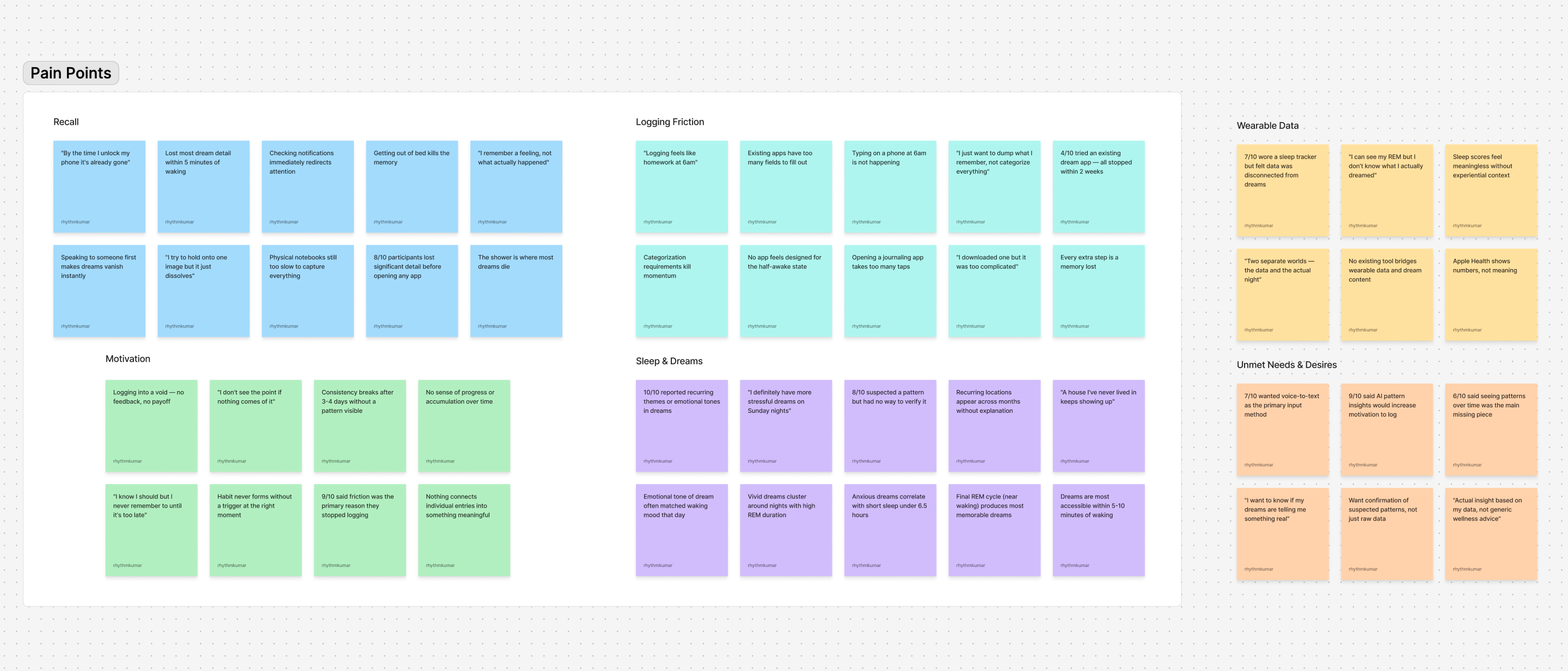
I interviewed 10 participants aged 22 to 34, a mix of students and young professionals with self-reported interest in sleep quality or personal growth. 7 of 10 wore a sleep tracker.
01
Recall fades faster than anyone expects.
8 of 10 participants lost most dream content within 5 minutes of waking. The moment they checked their phone was when recall dropped.
02
Logging feels like homework at 6am.
9 of 10 said they would log more if the experience was faster and lower friction. 4 of 10 had tried an existing dream app and all stopped within 2 weeks.
03
The data exists. The connection does not.
7 of 10 wore a sleep tracker but felt the data was completely disconnected from their actual dream experience. 9 of 10 said AI-generated pattern insights would be valuable if based on their own data.
Solution
The capture moment is everything.
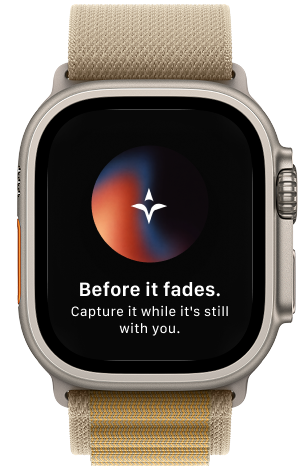
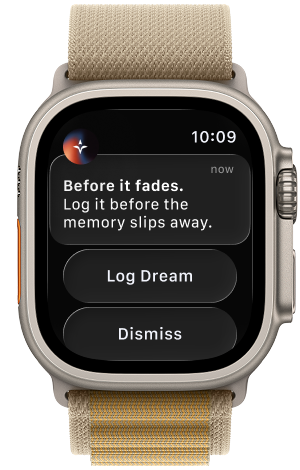
A haptic notification fires the moment Apple Watch detects REM sleep ending. Two taps: Log Dream or Dismiss. No app to open, no friction, no lost memory. The log screen that follows is a single large text field, mood tags, and an optional voice input. Nothing else. The home screen then surfaces last night's dream alongside sleep data pulled directly from Apple Health, connecting what you dreamt to how you slept.
Design Decisions
Why we built it this way.
The Library is a living archive, not a list.
Every logged dream becomes a card in a growing visual collection anchored to real sleep data. The grid is image-first by design. You recognize a dream by its photograph before you read anything else. A mood filter surfaces your entire archive by emotional tone, revealing patterns without needing a chart. Tapping a dream opens the full detail view where sleep data, dream text, and AI insight converge into one coherent read.
Data that feels like something.
The Insights page plots REM duration against recall quality as a dual waveform — waveforms instead of bar charts because sleep has rhythm, not discrete units. Below the chart, seven mood categories float as gradient aura blobs sized by frequency and colored by emotional tone. You understand the shape of your dream life before reading a single number. A glass card synthesizes it into plain language: what your patterns mean and what they suggest about your nervous system during sleep.
Patterns that feel like discovery, not a report.
Three AI-detected findings from across the dream archive, each anchored in real numbers from the user's own data. Sleep vs Recall. REM vs Intensity. Mood vs Timing. The stat chips are what make it credible: Every stat is computed from the user's own data, not generic wellness research. That specificity is what makes it feel true. At the bottom, a Tonight's Recommendation card shifts from retrospective to prospective. Not generic advice but the logical output of the user's own patterns applied to right now.
Design System
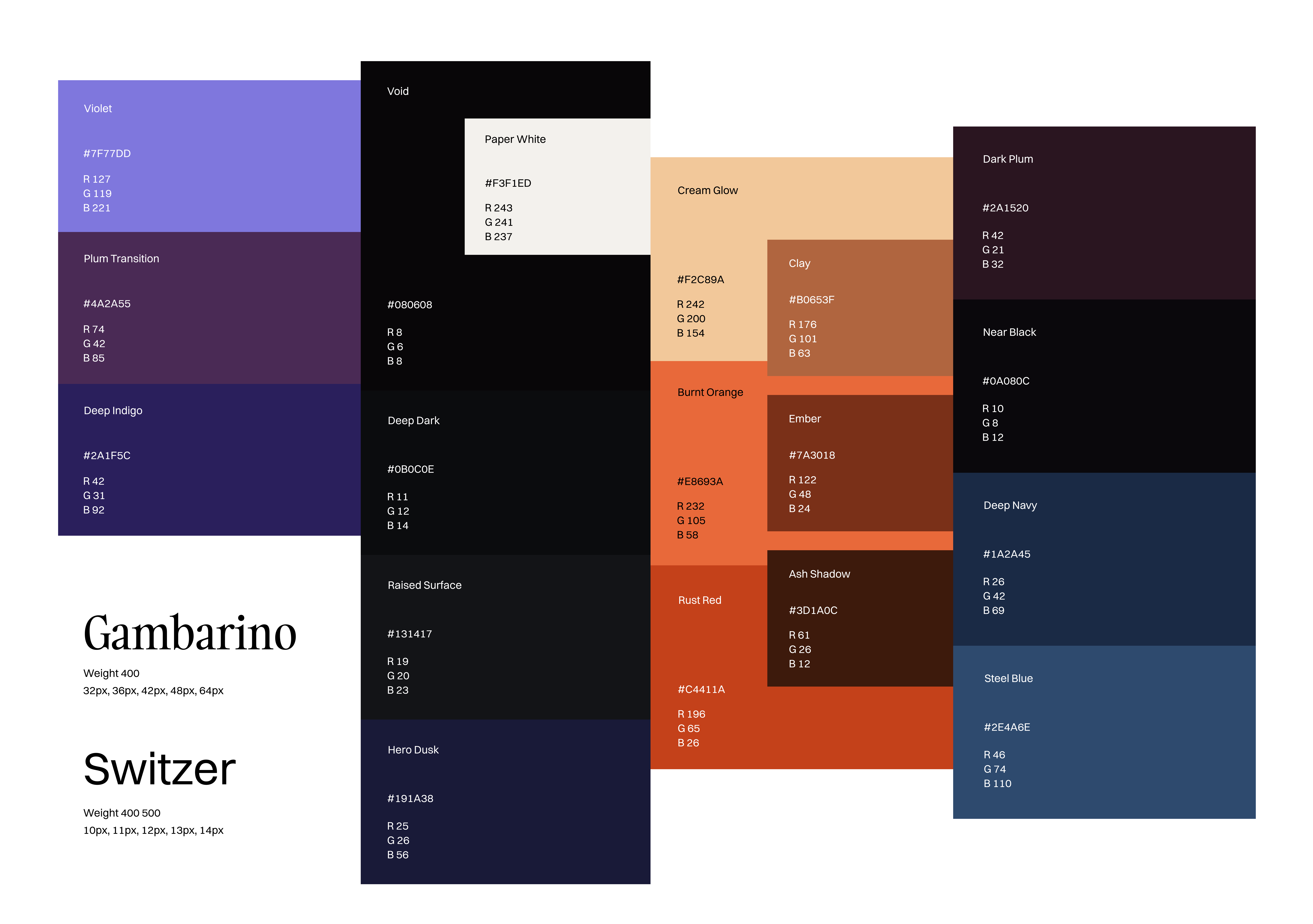
Built to feel like sleep.
Outcome
Designed end-to-end.
Reverie was designed as a full iOS concept across six core screens with a working prototype built in Protopie.
8 Screens
Full end-to-end iOS flow designed across 8 screens and prototyped in Figma Make
Apple Watch
Native integration with Health and haptic notification system
Reflection
What I learned.
01
Timing is a design decision.
The most important choice in this product had nothing to do with visual design. It was deciding when to interrupt the user. Getting that moment right made everything else possible.
02
Data needs an emotional layer.
Sleep scores are numbers. Reverie translates them into color, texture, and language that feels true to what the night actually was. Numbers alone do not create understanding.
03
Constraints sharpen the concept.
Designing within Apple Health and Apple Watch constraints forced clarity. Every feature had to justify its existence against the core promise: capture the dream before it disappears.