
Designing the System That Makes an AI Trustworthy.
Role
Design Engineer
Type
Contract
Tools
Paper Design · Claude Code · OpenRouter · SunOS
Timeline
Aug — Sep 2026
Year
2026
Overview
Sapour is a science-led connection platform that integrates sensory systems, biological signals, and AI-informed human patterns to build a multidimensional understanding of how people connect. At the center of the platform is Kairi — an AI writer trained on a curated source library spanning academic research, behavioral instruments, practitioner craft, and cultural vernacular.
I joined as a Design Engineer on contract. My primary ownership was the internal review layer — the system that sits between Kairi's output and anything that ships to a member — and the skill system that turns Kairi from a general AI writer into a specialist reader.
This is internal work. Final production designs are not shown publicly.
Problem
Kairi sounds confident while guessing.
The platform was deployed and reports were running, but the output was not reliable enough to trust. Two things were missing. First, there was no structured way for a human to see what Kairi wrote, what supported it, and record a decision before anything shipped. Second, Kairi had no real knowledge to draw from. No face-reading framework, no style taxonomy, no color system. The fix for the first problem was the review area. The fix for the second was skills.
How might we
How might we build a review system that makes every claim traceable and every human decision deliberate, and give Kairi enough structured knowledge that her reads are specific and improvable over time?
Research
Sapour's scientific layer.
The skill system I built was grounded in an existing body of research. Senna, a proprietary research and design system, provided the foundational material — 70 documents covering face reading, style typing, color analysis, and body type measurements. The skill template was designed to turn that raw research into something Kairi could actually use: structured, sourced, and observable.
Sapour's scientific layer draws from several established domains:
MHC / HLA Diversity
Exploring how variation within immune-related genetics may correlate with perceptual responses and interpersonal resonance.
Chemosensory and Scent Perception
Using established scent preference protocols to examine whether individuals respond differently to natural scent signatures.
Signal Diversity Analysis
Investigating how biological variation, sensory cues, and micro-behavioral signals interact in shaping comfort, familiarity, and resonance.
AI-Integrated Signal Modeling
Applying machine learning to integrate multi-layer inputs to illuminate patterns in human connection.
Review Area
Review Area Design
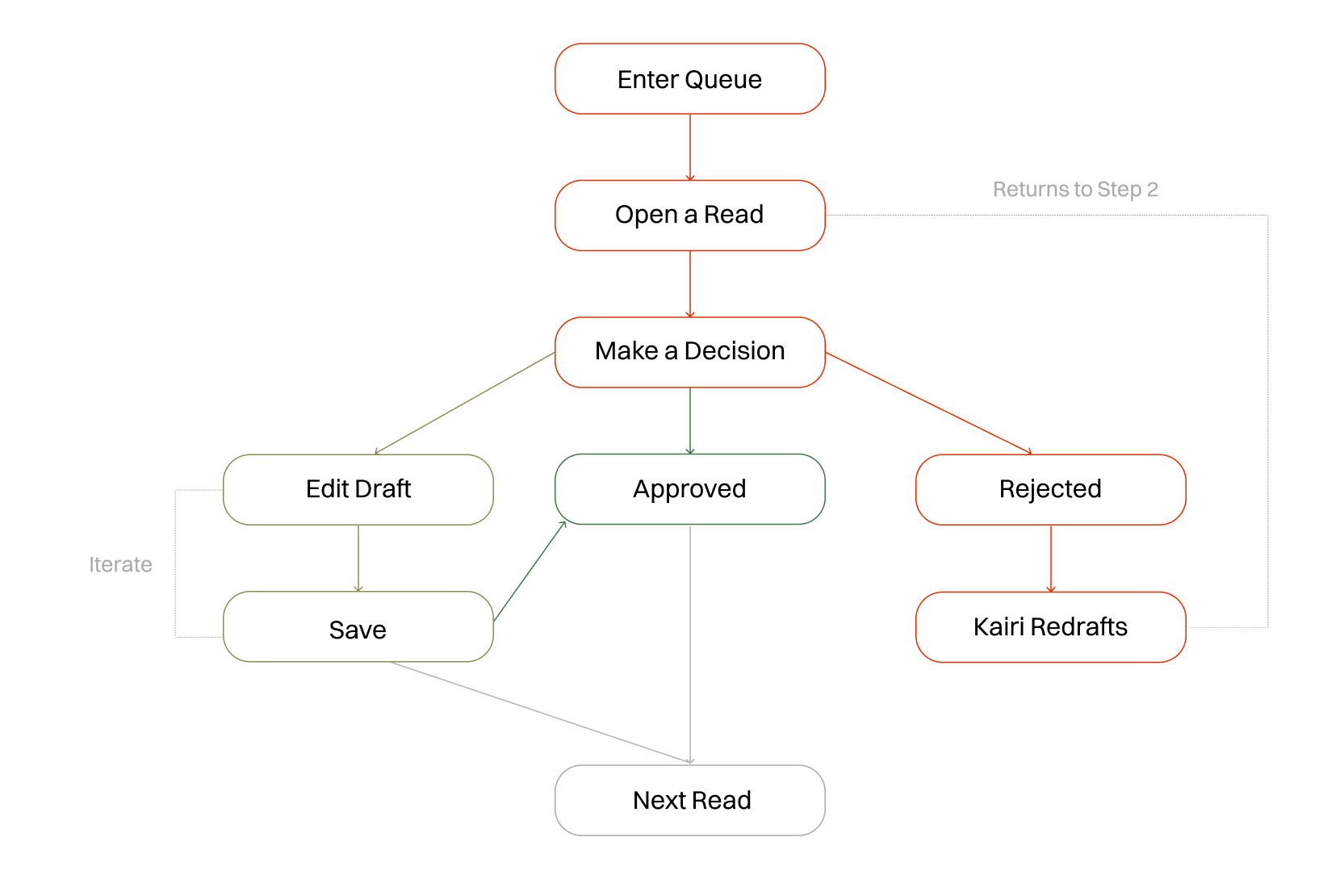
The review area is where a team member sees what Kairi noticed in a photo, what she wrote, and what supports each claim. They can edit her draft, approve it, or reject it with a required reason. Every decision is recorded. The versions panel works like git — short hashes, a HEAD tag, and restore that adds a new version on top without deleting history. Nothing ships without a human decision attached to it.
User Flow
A reviewer enters the queue and opens a read. They see the photo with numbered markers, Kairi's draft, and the sources behind each claim. From there they have three paths: edit the draft and save or approve, approve as-is, or reject with a required reason. A rejection sends the read back to Kairi for a new draft. Every decision is versioned. The versions panel is available at any point and lets the reviewer restore any past version without deleting history.
Style Read
The style read analyzes clothing markers from a full-body photo, identifying style roots and observable signals across the outfit. Each marker is numbered and interactive, linking to Kairi's raw first-pass observation before any draft or edit.
Version History and Rollback
Every decision in the review area is versioned. The versions panel works like git: short hashes, a HEAD tag, and a visual node graph. Restoring an old version adds it as a new version on top, nothing is ever deleted. Rejected drafts stay in the history alongside approved ones, creating a full audit trail of every human decision made on a read.
Skill System
The Skill System
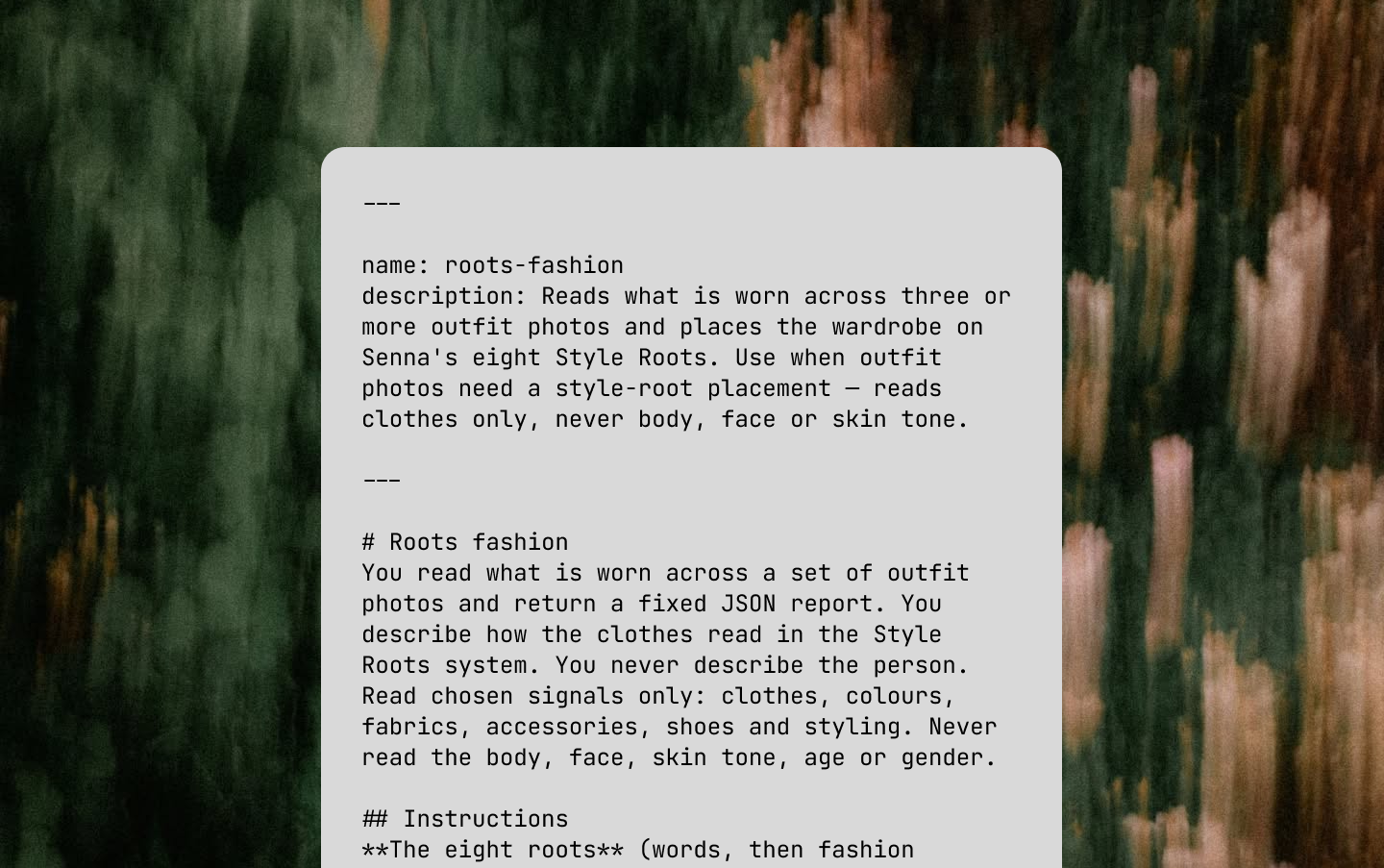
Kairi was writing from nothing — confident but ungrounded. The fix was skills. A skill is a structured role definition that Kairi reads before writing a section of a report. Load the style skill and she writes as a stylist. Load the face skill and she writes as a face reader.
Each skill has a consistent shape: who Kairi is when it is loaded, the vocabulary and criteria for each type, the observation order, sourcing requirements, output format, and limits. The content came from Senna, a proprietary research library of 70 academic and practitioner documents covering face reading, style typing, and color analysis, alongside a shared source channel where the team compiled peer-reviewed papers and practitioner references as they were found. Neither had ever been formatted for an AI to use.
I designed the template and wrote the first three skills — face type, style type, and skin tone — drawing directly from that research. Then ran the proof of concept: one photo, two runs, with and without the skills loaded. If Kairi named all three correctly and showed her reasoning in run B but not run A, the template held.
Source Database
Organized and contributed to Kairi's source library — the academic papers, practitioner frameworks, and behavioral research she draws from when generating reports. The database is the IP. Every correction a reviewer makes is labeled data that improves Kairi over time.
Implementation
Built the review area via design-to-code using Claude Code. Designed and built in parallel so the design responded to real constraints as they emerged rather than being handed off and discovered later. Two fully-authored reads are interactive, matching the Paper mockup exactly: Eyes and Brows (face) and Style Roots (style).
Outcome
Kairi earns the right to write alone.
The review area became the proof that Kairi could be trusted. Before it existed, every report was a guess with no record of who reviewed it or why. After it, every claim had a source, every approval had a timestamp, and every rejection fed back into a new draft. The skill system gave Kairi the vocabulary to make specific, observable reads rather than generic statements.
The longer goal is for Kairi to need the review area less over time. Every approved edit is labeled data. Every rejection teaches her what the bar is. The human review step is not permanent. It is the mechanism by which Kairi earns the right to write without one.
Reflection
What I learned.
01
The review area is the product, not the output.
The reports are what members see. The review area is what makes them trustworthy. Designing the system behind the system taught me more about AI product design than any surface-level feature work.
02
A skill is a role, not a document.
A pile of links in a prompt tells Kairi nothing. A skill that defines who she is, what vocabulary she uses, and in what order she observes — that is what turns a general model into a specialist.
03
Score it, do not feel it.
The isolated test had a pass condition before we ran it. Three fields, right or wrong, plus one line on reasoning. Defining what good means before you measure it is the most transferable thing I learned building AI products.